


Presea 9.36 SC
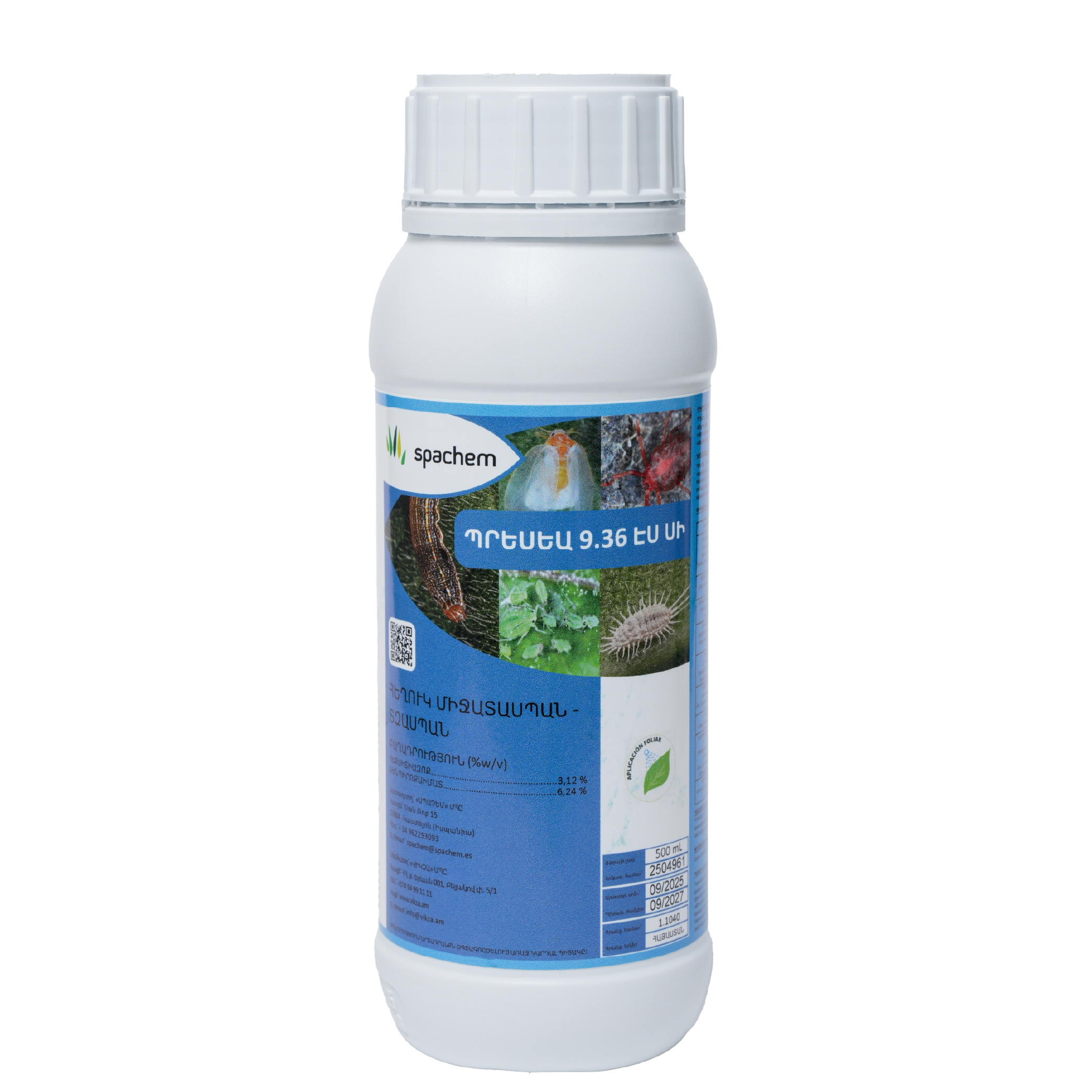
100ml, 250ml, 500ml, 1L, 5L, 10L, 20L, 200L, 1000L

PRESEA 9.36 SC contains FENPYROXIMATE + HEXYTHIAZOX is a selective adulticidal and ovicidal, translaminar insecticide-acaricide that acts by contact and ingestion. It has activity in all stages of mite development, a good shock effect and a prolonged residual effect.
PRESEA 9.36 SC is an acaricide that mixes the action of two active ingredients: Hexithiazox, which acts by inhibiting the biosynthesis of chitin, causing alterations in molting, growth and development of the immature stages of the mites, it is also has demonstrated an effect on adult females, causing their sterilization (the clutches of treated females are not viable); and Fenpyroximate, which acts by inhibiting electron transport in the mitochondrial complex.
| CROPS | Pests | DOSE (L/Ha) |
|---|---|---|
| Fruit trees (peach, nectarine, plum, cherry, apricot, kumquat, pear, apple, pomegranate, persimmon, fig etc.) | Mites (Panonychus spp / Olygonychus spp) |
0.5 - 0.75 |
| Fruit trees (peach, nectarine, plum, cherry, apricot, kumquat, pear, apple, pomegranate, persimmon, fig etc.) | Comstock mealybug (Pseudococcus comstocki) |
0.5 - 0.75 |
| Fruit trees (peach, nectarine, plum, cherry, apricot, kumquat, pear, apple, pomegranate, persimmon, fig etc.) | Bituberculate Scale (Palaeolecanium bituberculatum) |
0.5 - 0.75 |
| Fruit trees (peach, nectarine, plum, cherry, apricot, kumquat, pear, apple, pomegranate, persimmon, fig etc.) | European fruit lecanium (Parthenolecanium corni) |
0.5 - 0.75 |
| Fruit trees (peach, nectarine, plum, cherry, apricot, kumquat, pear, apple, pomegranate, persimmon, fig etc.) | Olive scale (Parlatoria oleae) |
0.5 - 0.75 |
| Fruit trees (peach, nectarine, plum, cherry, apricot, kumquat, pear, apple, pomegranate, persimmon, fig etc.) | Belted soft scale (Didesmococcus unifasiatus) |
0.5 - 0.75 |
| Fruit trees (peach, nectarine, plum, cherry, apricot, kumquat, pear, apple, pomegranate, persimmon, fig etc.) | Armenian comma hard scale (Lepidosaphes malicola) |
0.5 - 0.75 |
| Fruit trees (peach, nectarine, plum, cherry, apricot, kumquat, pear, apple, pomegranate, persimmon, fig etc.) | Californian scale (Quadraspidiotus perniciosus) |
0.5 - 0.75 |
| Fruit trees (peach, nectarine, plum, cherry, apricot, kumquat, pear, apple, pomegranate, persimmon, fig etc.) | Transcaucasia marble beetle (Polyphylla olivieri) |
0.4 - 0.5 |
| Fruit trees (peach, nectarine, plum, cherry, apricot, kumquat, pear, apple, pomegranate, persimmon, fig etc.) | Red spider mite (Tetranychus urticae) |
0.4 - 0.5 |
| Fruit trees (peach, nectarine, plum, cherry, apricot, kumquat, pear, apple, pomegranate, persimmon, fig etc.) | Grape (citrus) mealybug (Pseudococcus citri) |
0.5 - 0.75 |
| Vegetables (tomato, pepper, chili, eggplant, potato, carrot, zucchini) | Mites (Tetranychus spp/Panonychus spp) |
0.5 - 0.75 |
| Vegetables (tomato, pepper, chili, eggplant, potato, carrot, zucchini) | Red spider mite (Tetranychus urticae) |
0.4 - 0.5 |
| Edible leaf crops (cabbage, lettuce, broccoli, spinach) | Mites (Tetranychus spp) |
0.5 - 0.75 |
| Edible leaf crops (cabbage, lettuce, broccoli, spinach) | Red spider mite (Tetranychus urticae) |
0.4 - 0.5 |
| Liliaceas and other crucifera (garlic, onion, asparagus, turnip, radishes) | Mites (Tetranychus spp) |
0.5 - 0.75 |
| Liliaceas and other crucifera (garlic, onion, asparagus, turnip, radishes) | Red spider mite (Tetranychus urticae) |
0.4 - 0.5 |
| Extensive and industrial (wheat, corn, barley, tabaci, beet) | Mites (Steneotarsonemus spp / Tetranychus spp / Pononychus spp) |
0.5 - 0.75 |
| Extensive and industrial (wheat, corn, barley, tabaci, beet) | Red spider mite (Tetranychus urticae) |
0.4 - 0.5 |
| Berries (strawberry, raspberry, blueberry, blackberries, currant, vine) | Mites (Tetranychus spp) |
0.5 - 0.75 |
| Berries (strawberry, raspberry, blueberry, blackberries, currant, vine) | European fruit lecanium (Parthenolecanium corni) |
0.5 - 0.75 |
| Berries (strawberry, raspberry, blueberry, blackberries, currant, vine) | Armenian comma hard scale (Lepidosaphes malicola) |
0.5 - 0.75 |
| Berries (strawberry, raspberry, blueberry, blackberries, currant, vine) | Grape thrips (Drepanothrips reuteri) |
0.4 - 0.5 |
| Berries (strawberry, raspberry, blueberry, blackberries, currant, vine) | Grape phylloxera (Phylloxera vastatrix) |
0.4 - 0.5 |
| Berries (strawberry, raspberry, blueberry, blackberries, currant, vine) | European grapevine moth (Polychrosis botrana) |
0.4 - 0.5 |
| Berries (strawberry, raspberry, blueberry, blackberries, currant, vine) | Transcaucasia marble beetle (Polyphylla olivieri) |
0.4 - 0.5 |
| Berries (strawberry, raspberry, blueberry, blackberries, currant, vine) | Red spider mite (Tetranychus urticae) |
0.4 - 0.5 |
| Berries (strawberry, raspberry, blueberry, blackberries, currant, vine) | Grape Spider Mite (Schizotetranychus viticola) |
0.5 - 0.75 |
| Berries (strawberry, raspberry, blueberry, blackberries, currant, vine) | Grape erineum mite (Eriophyes vitis) |
0.6 - 0.7 |
| Berries (strawberry, raspberry, blueberry, blackberries, currant, vine) | Grape leafhopper (Zygina párvula) |
0.4 - 0.5 |
| Berries (strawberry, raspberry, blueberry, blackberries, currant, vine) | Comstock mealybug (Pseudococcus comstocki) |
0.5 - 0.75 |
| Berries (strawberry, raspberry, blueberry, blackberries, currant, vine) | Bituberculate Scale (Palaeolecanium bituberculatum) |
0.5 - 0.75 |
| Berries (strawberry, raspberry, blueberry, blackberries, currant, vine) | Olive scale (Parlatoria oleae) |
0.5 - 0.75 |
| Berries (strawberry, raspberry, blueberry, blackberries, currant, vine) | Belted soft scale (Didesmococcus unifasiatus) |
0.5 - 0.75 |
| Berries (strawberry, raspberry, blueberry, blackberries, currant, vine) | Californian scale (Quadraspidiotus perniciosus) |
0.5 - 0.75 |
| Berries (strawberry, raspberry, blueberry, blackberries, currant, vine) | Grape (citrus) mealybug (Pseudococcus citri) |
0.5 - 0.75 |
| Cucurbitaceas (melon, watermelon, pumpkin) | Mites (Tetranychus spp/Panonychus spp) |
0.5 - 0.75 |
| Cucurbitaceas (melon, watermelon, pumpkin) | Red spider mite (Tetranychus urticae) |
0.4 - 0.5 |
| Aromatic and ornamental (cilantro, parsley, mint, sage, rosemary, thyme, tarragon, rose, gerberas, thuja, fir tree, carnations) | Mites (Tetranychus spp) |
0.5 - 0.75 |
| Aromatic and ornamental (cilantro, parsley, mint, sage, rosemary, thyme, tarragon, rose, gerberas, thuja, fir tree, carnations) | Comstock mealybug (Pseudococcus comstocki) |
0.5 - 0.75 |
| Aromatic and ornamental (cilantro, parsley, mint, sage, rosemary, thyme, tarragon, rose, gerberas, thuja, fir tree, carnations) | Olive scale (Parlatoria oleae) |
0.5 - 0.75 |
| Aromatic and ornamental (cilantro, parsley, mint, sage, rosemary, thyme, tarragon, rose, gerberas, thuja, fir tree, carnations) | Armenian comma hard scale (Lepidosaphes malicola) |
0.5 - 0.75 |
| Aromatic and ornamental (cilantro, parsley, mint, sage, rosemary, thyme, tarragon, rose, gerberas, thuja, fir tree, carnations) | Californian scale (Quadraspidiotus perniciosus) |
0.5 - 0.75 |
| Aromatic and ornamental (cilantro, parsley, mint, sage, rosemary, thyme, tarragon, rose, gerberas, thuja, fir tree, carnations) | Red spider mite (Tetranychus urticae) |
0.4 - 0.5 |
| Aromatic and ornamental (cilantro, parsley, mint, sage, rosemary, thyme, tarragon, rose, gerberas, thuja, fir tree, carnations) | Bituberculate Scale (Palaeolecanium bituberculatum) |
0.5 - 0.75 |
| Aromatic and ornamental (cilantro, parsley, mint, sage, rosemary, thyme, tarragon, rose, gerberas, thuja, fir tree, carnations) | European fruit lecanium (Parthenolecanium corni) |
0.5 - 0.75 |
| Aromatic and ornamental (cilantro, parsley, mint, sage, rosemary, thyme, tarragon, rose, gerberas, thuja, fir tree, carnations) | Belted soft scale (Didesmococcus unifasiatus) |
0.5 - 0.75 |
| Legumes (beans, peas, lentils) | Mites (Tetranychus spp) |
0.5 - 0.75 |
| Legumes (beans, peas, lentils) | Red spider mite (Tetranychus urticae) |
0.4 - 0.5 |
Presea 9.36 SC
PRESEA 9.36 SC contains FENPYROXIMATE + HEXYTHIAZOX is a selective adulticidal and ovicidal, translaminar insecticide-acaricide that acts by contact and ingestion. It has activity in all stages of mite development, a good shock effect and a prolonged residual effect.
PRESEA 9.36 SC is an acaricide that mixes the action of two active ingredients: Hexithiazox, which acts by inhibiting the biosynthesis of chitin, causing alterations in molting, growth and development of the immature stages of the mites, it is also has demonstrated an effect on adult females, causing their sterilization (the clutches of treated females are not viable); and Fenpyroximate, which acts by inhibiting electron transport in the mitochondrial complex.
- Hexitiazox 3.12 %
- Fenpyroximate 6.24 %
PRESEA 9.36 SC is a contact and ingestion acaricide. It is applied by spraying with ground spray equipment, after mixing with water. Prepare a premix according to the indicated dose with half the volume of the water to be used, shake until the product is well dissolved and complete the application volume.
According to IRAC (Insecticide Resistance Action Committee), PRESEA 9.36 is part of group 10 (Hexitiazox) and 21 (Fenpyroximate), thus reducing the risk of resistance.COMPOSICIÓN:
Formulation: Concentrated suspension
MAXIMUM NUMBER OF TREATMENTS
1
Regulate the pH.
The effectivenes of treatments are provided by a complete follage wettiness and use of adjuvant.
INTERVAL BETWEEN LAST APPLICATION AND HARVEST (WAITING PERIOD)
24 h
PRESEA 9.36 SC is recommended to be applied on clean, dust-free plants to increase the efficiency of the product. Pre-wash the plants before application.
- Avoid application when strong winds are present.
- Apply early in the morning or of the day.
- Use personal protective equipment during handling, mixing and application of the product.
- Ensure that the application of the product is uniform, verifying that the application equipment is properly calibrated.
- Rotate with products with different modes of action to avoid the development of resistance in the target pest.
PRESEA 9.36 SC is compatible with most commonly used pesticides, except carbonated waters, acids, strong bases and oxidizing agents. It is recommended to carry out a prior compatibility test.
PHYTOTOXICITYIt is not phytotoxic when used according to the recommendations and doses of SPACHEM S.L. In case of mixing, perform a small scale test to check compatibility and phytotoxicity.
REMARKS
The recommendations and information we provide are the result of extensive and rigorous studies and tests, however, numerous factors beyond our control may intervene in the use (preparation of mixtures, application, weather, etc.). The company guarantees the composition, formulation and content. The user will be liable for any damage caused ( lack of efficacy, general toxicity, residues, etc.) due to total or partial non-observance of the label instructions.
- Verify the correct calibration of the equipment before starting the application
- Put water halfway up the tank of the applicator equipment, add the necessary amount of PRESEA 9.36 SC product according to the dose recommended on this label, keeping the shaker running and top up with the rest of the volume of water.
- It is recommended to add a non-ionic adjuvant to improve coverage.
- Before starting any treatment, it is essential to verify the correct calibration of the equipment and the proper functioning of the nozzles (filters and pads), replacing the defective parts.
- Do not perform applications with high temperatures.
- Apply away from springs, courses, or fountains.
- Always calibrate your equipment with water only before applying the product.
- Remember to get the right auxiliary equipment (solid and liquid product meters), graduated trays, stirring paddles, brushes, brushes, etc.
- Use the following protective equipment for mixing, loading, and applying: boots, mask, goggles, gloves, and dispenser.
The icon identifies products designed for direct application to leaves, where nutrients and biostimulants are rapidly absorbed through the stomatal and cuticular pathways.