


Yakarta 22.25 EC
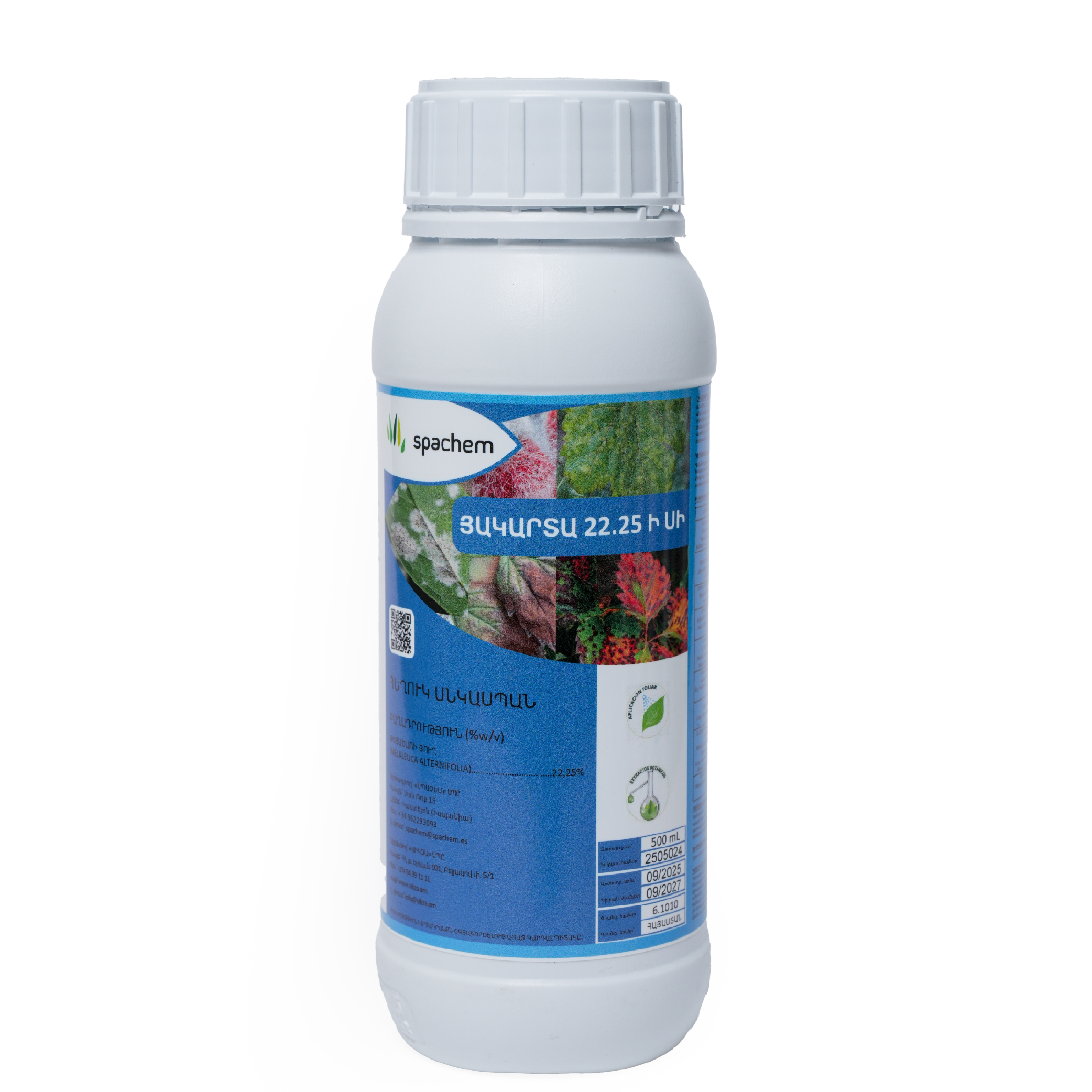
100ml, 250ml, 500ml, 1L, 5L, 10L, 20L, 200L, 1000L




YAKARTA 22.25 EC is a fungicide with both preventive and curative action. Its active material is the tea tree extract (Melaleuca alternifolia).
| CROPS | PLAGUE | DOSE (L/Ha) |
|---|---|---|
| Fruit trees (peach, nectarine, plum, cherry, apricot, kumquat, pear, apple, pomegranate, persimmon, fig etc.) | Mildew (Mildiu) |
1 - 1.5 |
| Fruit trees (peach, nectarine, plum, cherry, apricot, kumquat, pear, apple, pomegranate, persimmon, fig etc.) | Apple powdery mildew (Podosphaera leucotricha) |
1.4 - 2.0 |
| Fruit trees (peach, nectarine, plum, cherry, apricot, kumquat, pear, apple, pomegranate, persimmon, fig etc.) | Powdery mildew of peach (Sphaerotheca pannosa) |
1 - 1.5 |
| Fruit trees (peach, nectarine, plum, cherry, apricot, kumquat, pear, apple, pomegranate, persimmon, fig etc.) | Root rot (Fusarium avenaceum) |
1 - 1.4 |
| Fruit trees (peach, nectarine, plum, cherry, apricot, kumquat, pear, apple, pomegranate, persimmon, fig etc.) | Root rot (Fusarium graminearum) |
1 - 1.4 |
| Fruit trees (peach, nectarine, plum, cherry, apricot, kumquat, pear, apple, pomegranate, persimmon, fig etc.) | Powdery mildew (Oidio spp) |
1.5 - 2 |
| Fruit trees (peach, nectarine, plum, cherry, apricot, kumquat, pear, apple, pomegranate, persimmon, fig etc.) | Faba bean fusarium wilt (Fusarium oxysporum) |
0.8 - 1.6 |
| Vegetables (tomato, pepper, chili, eggplant, potato, carrot, zucchini) | Rot (Alternaria spp) |
1.5 - 2 |
| Vegetables (tomato, pepper, chili, eggplant, potato, carrot, zucchini) | Carrot black rot (Alternaria radicina) |
1.5 - 2 |
| Vegetables (tomato, pepper, chili, eggplant, potato, carrot, zucchini) | Potato brown leaf spot (Cercospora concors) |
0.6 - 1.0 |
| Vegetables (tomato, pepper, chili, eggplant, potato, carrot, zucchini) | Powdery mildew of potato (Erysiphe cichoracearum) |
0.8 - 1.6 |
| Vegetables (tomato, pepper, chili, eggplant, potato, carrot, zucchini) | Powdery mildew of Alfalfa (Erysiphe communis) |
1 - 2.0 |
| Vegetables (tomato, pepper, chili, eggplant, potato, carrot, zucchini) | Cabbage root wilt (Fusarium oxysporum var. orthoceras Bil) |
1 - 1.5 |
| Vegetables (tomato, pepper, chili, eggplant, potato, carrot, zucchini) | Potato rot or fusarium (Fusarium solani) |
0.8 - 1.6 |
| Vegetables (tomato, pepper, chili, eggplant, potato, carrot, zucchini) | Powdery mildew of tomato (Leveillula taurica) |
1.0 - 1.5 |
| Vegetables (tomato, pepper, chili, eggplant, potato, carrot, zucchini) | Macrosporiosis (Macrosporium solani (Alternaria solani)) |
1 - 1.5 |
| Vegetables (tomato, pepper, chili, eggplant, potato, carrot, zucchini) | Black scurf or rhizoctonia (Rhizoctonia solani) |
1 - 2.0 |
| Vegetables (tomato, pepper, chili, eggplant, potato, carrot, zucchini) | Root rot (Fusarium avenaceum) |
1 - 1.4 |
| Vegetables (tomato, pepper, chili, eggplant, potato, carrot, zucchini) | Root rot (Fusarium graminearum) |
1 - 1.4 |
| Vegetables (tomato, pepper, chili, eggplant, potato, carrot, zucchini) | Tomato fake powdery mildew (Phytophthora infestans) |
0.25 - 0.3 |
| Vegetables (tomato, pepper, chili, eggplant, potato, carrot, zucchini) | Root rot of sprouts (Pythium debaryanum) |
0.75 - 1 |
| Vegetables (tomato, pepper, chili, eggplant, potato, carrot, zucchini) | Grey mould (Botrytis spp) |
1 - 2 |
| Vegetables (tomato, pepper, chili, eggplant, potato, carrot, zucchini) | Powdery mildew (Oidio spp) |
1 - 2 |
| Vegetables (tomato, pepper, chili, eggplant, potato, carrot, zucchini) | Faba bean fusarium wilt (Fusarium oxysporum) |
1.5 - 2.5 |
| Edible leaf crops (cabbage, lettuce, broccoli, spinach) | Rot (Alternaria spp) |
1.5 - 2 |
| Edible leaf crops (cabbage, lettuce, broccoli, spinach) | Powdery mildew of Alfalfa (Erysiphe communis) |
1 - 2.0 |
| Edible leaf crops (cabbage, lettuce, broccoli, spinach) | Root rot (Fusarium avenaceum) |
1 - 1.4 |
| Edible leaf crops (cabbage, lettuce, broccoli, spinach) | Root rot (Fusarium graminearum) |
1 - 1.4 |
| Edible leaf crops (cabbage, lettuce, broccoli, spinach) | Cabbage root wilt (Fusarium oxysporum var. orthoceras Bil) |
1 - 1.5 |
| Edible leaf crops (cabbage, lettuce, broccoli, spinach) | Potato rot or fusarium (Fusarium solani) |
0.8 - 1.6 |
| Edible leaf crops (cabbage, lettuce, broccoli, spinach) | Grey mould (Botrytis spp) |
1 - 2 |
| Edible leaf crops (cabbage, lettuce, broccoli, spinach) | Powdery mildew (Oidio spp) |
1 - 2 |
| Edible leaf crops (cabbage, lettuce, broccoli, spinach) | Faba bean fusarium wilt (Fusarium oxysporum) |
0.8 - 1.6 |
| Liliaceas and other crucifera (garlic, onion, asparagus, turnip, radishes) | Rot (Alternaria spp) |
1.5 - 2 |
| Liliaceas and other crucifera (garlic, onion, asparagus, turnip, radishes) | Root rot (Fusarium avenaceum) |
1 - 1.4 |
| Liliaceas and other crucifera (garlic, onion, asparagus, turnip, radishes) | Root rot (Fusarium graminearum) |
1 - 1.4 |
| Liliaceas and other crucifera (garlic, onion, asparagus, turnip, radishes) | Grey mould (Botrytis spp) |
1 - 2 |
| Liliaceas and other crucifera (garlic, onion, asparagus, turnip, radishes) | Powdery mildew (Oidio spp) |
1 - 2 |
| Liliaceas and other crucifera (garlic, onion, asparagus, turnip, radishes) | Faba bean fusarium wilt (Fusarium oxysporum) |
0.8 - 1.6 |
| Extensive and industrial (wheat, corn, barley, tabaci, beet) | Rot (Alternaria spp) |
0.6 - 0.8 |
| Extensive and industrial (wheat, corn, barley, tabaci, beet) | Snow mold (Fusarium nivale) |
1 - 1.4 |
| Extensive and industrial (wheat, corn, barley, tabaci, beet) | Helminthosporium / (Stripe rust) (Helminthosporium gramineum) |
1.5 - 2.5 |
| Extensive and industrial (wheat, corn, barley, tabaci, beet) | Helminthosporium leaf blight (Helminthosporium sativum) |
1.5 - 2.5 |
| Extensive and industrial (wheat, corn, barley, tabaci, beet) | Root rot (Helminthosporium teres) |
1.5 - 2.5 |
| Extensive and industrial (wheat, corn, barley, tabaci, beet) | Tobacco fake powdery mildew (Peronospora tabacina) |
1 - 1.5 |
| Extensive and industrial (wheat, corn, barley, tabaci, beet) | Cotton rot (Rhizoctonia Aderholdii Kolosch) |
0.75 - 1 |
| Extensive and industrial (wheat, corn, barley, tabaci, beet) | Black scurf or rhizoctonia (Rhizoctonia solani) |
1 - 2.0 |
| Extensive and industrial (wheat, corn, barley, tabaci, beet) | Gray ear rot of maize (Rhizopus maydis) |
1 - 2 |
| Extensive and industrial (wheat, corn, barley, tabaci, beet) | Sclerotinia (Sclerotinia graminearum) |
1.5 - 2.0 |
| Extensive and industrial (wheat, corn, barley, tabaci, beet) | Root rot (Fusarium avenaceum) |
1 - 1.4 |
| Extensive and industrial (wheat, corn, barley, tabaci, beet) | Root rot (Fusarium graminearum) |
1 - 1.4 |
| Extensive and industrial (wheat, corn, barley, tabaci, beet) | Root rot of sprouts (Pythium debaryanum) |
0.75 - 1 |
| Extensive and industrial (wheat, corn, barley, tabaci, beet) | Cercosporiosis (Cercospora spp) |
0.6 - 0.8 |
| Extensive and industrial (wheat, corn, barley, tabaci, beet) | Faba bean fusarium wilt (Fusarium oxysporum) |
0.8 - 1.6 |
| Berries (strawberry, raspberry, blueberry, blackberries, currant, vine) | Powdery mildew (Oidio spp) |
1.0 - 1.5 |
| Berries (strawberry, raspberry, blueberry, blackberries, currant, vine) | Grey mould (Botrytis spp) |
1.5 |
| Berries (strawberry, raspberry, blueberry, blackberries, currant, vine) | Gray mold of grapes (Botrytis cinerea) |
1.5 - 2.5 |
| Berries (strawberry, raspberry, blueberry, blackberries, currant, vine) | Black rot of blackberries (Rhizopus nigricans) |
1.5 - 2.0 |
| Berries (strawberry, raspberry, blueberry, blackberries, currant, vine) | Powdery mildew of strawberry (Sphaerotheca macularis f. fragariae) |
1 - 1.5 |
| Berries (strawberry, raspberry, blueberry, blackberries, currant, vine) | Grape powdery mildew (Uncinula necator) |
1 - 2.0 |
| Berries (strawberry, raspberry, blueberry, blackberries, currant, vine) | Root rot (Fusarium avenaceum) |
1 - 1.4 |
| Berries (strawberry, raspberry, blueberry, blackberries, currant, vine) | Root rot (Fusarium graminearum) |
1 - 1.4 |
| Berries (strawberry, raspberry, blueberry, blackberries, currant, vine) | Faba bean fusarium wilt (Fusarium oxysporum) |
0.8 - 1.6 |
| Cucurbitaceas (melon, watermelon, pumpkin) | Powdery mildew (Oidio spp) |
1.5 - 2 |
| Cucurbitaceas (melon, watermelon, pumpkin) | Fake downy mildew of cucurbits (Pseudoperonospora cubensis) |
1 - 1.5 |
| Cucurbitaceas (melon, watermelon, pumpkin) | Powdery mildew of cucurbits (Erysiphe fuliginea) |
0.8 - 1.6 |
| Cucurbitaceas (melon, watermelon, pumpkin) | Root rot (Fusarium avenaceum) |
1 - 1.4 |
| Cucurbitaceas (melon, watermelon, pumpkin) | Root rot (Fusarium graminearum) |
1 - 1.4 |
| Cucurbitaceas (melon, watermelon, pumpkin) | Faba bean fusarium wilt (Fusarium oxysporum) |
0.8 - 1.6 |
| Aromatic and ornamental (cilantro, parsley, mint, sage, rosemary, thyme, tarragon, rose, gerberas, thuja, fir tree, carnations) | Mildew (Mildiu) |
1 - 2 |
| Aromatic and ornamental (cilantro, parsley, mint, sage, rosemary, thyme, tarragon, rose, gerberas, thuja, fir tree, carnations) | Root rot (Fusarium avenaceum) |
1 - 1.4 |
| Aromatic and ornamental (cilantro, parsley, mint, sage, rosemary, thyme, tarragon, rose, gerberas, thuja, fir tree, carnations) | Root rot (Fusarium graminearum) |
1 - 1.4 |
| Aromatic and ornamental (cilantro, parsley, mint, sage, rosemary, thyme, tarragon, rose, gerberas, thuja, fir tree, carnations) | Powdery mildew (Oidio spp) |
1.5 - 2 |
| Aromatic and ornamental (cilantro, parsley, mint, sage, rosemary, thyme, tarragon, rose, gerberas, thuja, fir tree, carnations) | Faba bean fusarium wilt (Fusarium oxysporum) |
0.8 - 1.6 |
| Legumes (beans, peas, lentils) | Mildew (Mildiu) |
1 - 2 |
| Legumes (beans, peas, lentils) | Powdery mildew of Alfalfa (Erysiphe communis) |
1 - 2.0 |
| Legumes (beans, peas, lentils) | Bean anthracnose (Colletotrichum lindemuthianum) |
0.75 - 1 |
| Legumes (beans, peas, lentils) | Root rot (Fusarium avenaceum) |
1 - 1.4 |
| Legumes (beans, peas, lentils) | Root rot (Fusarium graminearum) |
1 - 1.4 |
| Legumes (beans, peas, lentils) | Powdery mildew (Oidio spp) |
1.5 - 2 |
| Legumes (beans, peas, lentils) | Faba bean fusarium wilt (Fusarium oxysporum) |
0.8 - 1.6 |
Yakarta 22.25 EC
YAKARTA 22.25 EC is a fungicide with both preventive and curative action. Its active material is the tea tree extract (Melaleuca alternifolia).
- Tea tree oil (Melaleuca Alternifolia) 22.25 %
INTERVAL BETWEEN LAST APPLICATION AND HARVEST (WAITING PERIOD)
6 h․
MAXIMUM NUMBER OF TREATMENTS
Without restriction.
Regulate the pH.
The effectivenes of treatments are provided by a complete follage wettiness and use of adjuvant.
Crops in general:
-In times of incidence of the disease, under normal conditions, intervals of 7-10 days are established for preventive applications.
-When the first symptoms of infection appear, for curative applications, apply at maximum doses with intervals of 5-7 days.
Vine and fruit trees:
-For gray rot (Botrytis cinerea), perform applications with intervals of 7-10 days according to infestation conditions. Use maximum dose for healing applications with intervals of 3-5 days.
YAKARTA 22.25 EC acts in a preventive and curative way, by inhibiting the development of spore germination, inhibition of mycelial growth and expansive lesion; it produces inhibition in the production of sporangia, through the suppression and eradication of colonies of the pathogens present in the fruits and leaves. The way of contact action and also penetrating of YAKARTA 22.25 EC inhibits secondary contamination of the fungus to other healthy organs as it stops the growth and germination of the spores of the fungus as well as breaking the cell wall of the fungus producing a spill of the cytosol without affecting negative to the cells of the culture.
The product penetrates the mesophyll of the crop leaf through the cuticle and once inside prevents and stops the progression of the disease, it is therefore a highly effective product. It exerts its preventive action (protecting the crop before contracting the disease) and curative (avoiding the development of the pathogen) even when the first signs or symptoms of the disease are observed; and an eradicating action especially on the initial stages of the disease, preventing it from completing its infection process and consequently causing irreversible damage to the crop.
It is compatible with most commonly used insecticides, acaricides and fungicides, however it is essential to previously carry out a compatibility test. It is perfectly miscible in most oils currently used, as well as in water and oil emulsions. Not compatible with strong acid reaction products. Not compatible with phosphites.
PHYTOTOXICITYIt is not phytotoxic when used according to the recommendations and doses of SPACHEM S.L. In case of mixing, perform a small scale test to check compatibility and phytotoxicity.
REMARKS
The recommendations and information we provide are the result of extensive and rigorous studies and tests, however, numerous factors beyond our control may intervene in the use (preparation of mixtures, application, weather, etc.). The company guarantees the composition, formulation and content. The user will be liable for any damage caused ( lack of efficacy, general toxicity, residues, etc.) due to total or partial non-observance of the label instructions.
- Verify the correct calibration of the equipment before starting the application
- Put water halfway up the tank of the applicator equipment, add the necessary amount of YAKARTA 22.25 EC product according to the dose recommended on this label, keeping the shaker running and top up with the rest of the volume of water.
- It is recommended to add a non-ionic adjuvant to improve coverage.
- Before starting any treatment, it is essential to verify the correct calibration of the equipment and the proper functioning of the nozzles (filters and pads), replacing the defective parts.
- Do not perform applications with high temperatures.
- Apply away from springs, courses, or fountains.
- Always calibrate your equipment with water only before applying the product.
- Remember to get the right auxiliary equipment (solid and liquid product meters), graduated trays, stirring paddles, brushes, brushes, etc.
- Use the following protective equipment for mixing, loading, and applying: boots, mask, goggles, gloves, and dispenser.
The icon represents products formulated with natural extracts of plant origin, obtained from different botanical species.
The icon identifies products designed for direct application to leaves, where nutrients and biostimulants are rapidly absorbed through the stomatal and cuticular pathways.